
Transmission Lines
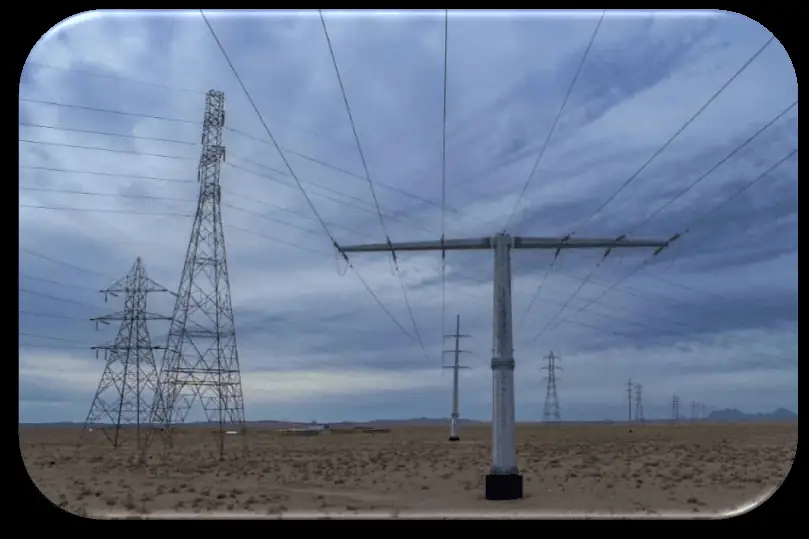
Transmission lines are a vital component of the power system, enabling the reliable transfer of electricity from renewable energy plants to the national grid and end users. They deliver efficient, safe, long-distance power while maintaining grid stability and minimising losses.
01Key Advantages
- Reliable transfer of large-scale renewable energy to the grid
- Voltage levels up to 400 kV for long-distance transmission
- Reduced transmission losses with optimised conductor design
- Support for grid stability and integration of variable renewables
- Expandability to meet future demand growth
02Applications
- Connection of utility-scale solar and wind farms to the grid
- Regional and inter-regional power transmission
- Industrial complexes and large infrastructure projects
- Hybrid projects combining PV, BESS and substations
- Electrification of remote areas through high-voltage lines
03Technical Features
- Overhead transmission lines (OHTL) — cost-effective for long distances and open terrain
- Underground cables — compact and ideal for urban or sensitive environments
- High-performance conductors with low-loss characteristics
- Modern insulation and protection technologies
- Advanced monitoring: thermal, fault detection and SCADA integration
- Compliance with IEC, IEEE and local grid codes
- Robust design against wind, ice and seismic loads
- In-house manufacturing of high-voltage transmission towers
04Capacity & Range
Indicative ranges — final design values are confirmed during the engineering phase.
| Parameter | Typical Value | Test Method |
|---|---|---|
| Voltage range | 20 kV – 400 kV | IEC 60826 |
| Line capacity | Tens – several hundred MW | IEEE 738 |
| Configurations | Single & double circuit, bundled conductors | IEC 61089 |
| Tower types | Suspension, tension, dead-end, transposition | ASCE 10-15 |
| Cable systems | XLPE up to 230 kV | IEC 62067 |
| Foundations | Pad & chimney, pile, rock anchor | EN 1997 |
05Delivery & Shipping Options
We deliver worldwide under Incoterms 2020 (FOB, CFR, CIF, DAP), with full documentation, third-party inspection and flexible packing.
Tower steel shipment
Galvanised angle sections bundled and shipped in 40' containers or break-bulk with full packing lists.
Conductor drums
ACSR/AAAC conductors on wooden or steel drums, sized for the stringing sections.
Right-of-way delivery
Off-road delivery to tower spots, including helicopter lift where terrain requires.
Galvanising certificate
Hot-dip galvanising thickness reports supplied with every consignment.
Related Services
Renewable & Solar Power Plants
Utility-scale PV farms, hybrid systems and grid-connected solar with full EPC delivery.
Read moreBattery Energy Storage (BESS)
Lithium-ion (LFP) cabinet and container systems for peak shaving, backup and arbitrage.
Read moreHigh Voltage Substations
AIS and GIS substations up to 400 kV, delivered as PC, EPC or turnkey contracts.
Read more